
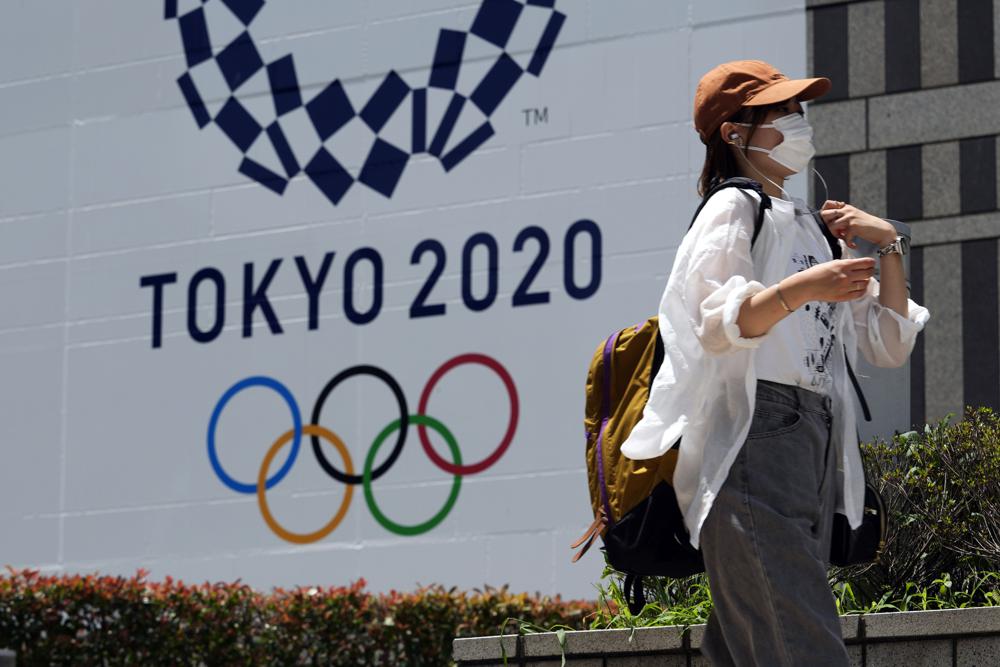
FILE - In this Tuesday, July 20, 2021, file photo, a woman wearing a protective mask walks in front of a Tokyo 2020 Summer Olympics display at the Tokyo Metropolitan government in Tokyo. The Tokyo Olympics have already broken new ground because of the 12-month delay caused by the coronavirus pandemic, pushing it into an odd-numbered year for the first time. But with no fans permitted in Japan, foreign or local, it has the undesirable distinction of being the first Games to be held with no spectators. (AP Photo/Kiichiro Sato, File)
|

An Olympics like no other, Tokyo perseveres to host Games

It’s an Olympics like no other — and the Tokyo Games are surely that — but this is an event that has persevered through wars, boycotts and now a pandemic over its 125-year modern history.

The Tokyo Olympics have already broken new ground because of the 12-month delay caused by the coronavirus pandemic, pushing it into an odd-numbered year for the first time. But with no fans permitted in Japan, foreign or local, it has the distinction of being the first Games without spectators.

“We’re in uncharted territory,” said Steve Wilson, the former president of the Olympic Journalists Association who covered the Olympic movement for The Associated Press for nearly three decades until 2017.

“These will be Games without the carnival atmosphere, celebration and fun that we’ve come to expect and look forward to. Definitely one for the history books.”

There have been many other unusual editions of the Olympics in the past, however. The United States and many of its allies boycotted the 1980 Moscow Games to protest the Soviet Union’s invasion of Afghanistan. The Soviets and many of its allies reciprocated four years later by boycotting the 1984 Los Angeles Olympics.

Dozens of countries, mainly from Africa, boycotted the 1976 Montreal Games to protest New Zealand’s sporting ties to the South African apartheid regime. South Africa was banned from competing from 1964 to 1988 because of apartheid.

World War I and World War II forced the Olympics to be canceled altogether, so there were no 1916, 1940 or 1944 Games. The separate Winter Olympics didn’t exist at the time of World War I, but World War II forced two of them to be called off.

The 1940 Games were supposed to be held in Tokyo, but upon the return of the Olympics in 1948, London was chosen as host. Tokyo had to wait until 1964 to host the Games for the first time.

And then there was 1920, an Olympics held in Antwerp, Belgium, that took place as the world was emerging from both World War I and a flu pandemic that killed more than 50 million people.

“In a minimum of time, they organized the Games, but they were relatively improvised Games,” Roland Renson, a Belgian sports historian, told the AP last year. “They had to do it with the means they had at their disposal, and they were at that time far from abundant in a city so heavily hit by war.”

The coronavirus pandemic even affected Antwerp’s 100-year anniversary, forcing last year’s celebrations to be canceled.

Another odd Olympic occurrence came at the 1956 Melbourne Games, when the equestrian events were held in Stockholm because of animal quarantine regulations in Australia.

And then there is the 1906 Athens Olympics, or maybe the lack of a 1906 Olympics.

Originally called the “Athens International Olympic Games” and sanctioned by the IOC, they are now known as the Intercalated (or Intermediary) Games of 1906 — hosted halfway between the normal four-year Olympic cycle. They were ruled unofficial in 1949, according to Olympic historian David Wallechinsky.

Tragedy has also marked the Olympics, most notably when 11 members of the Israeli team were murdered by the Palestinian terrorist group Black September at the 1972 Munich Games and when a bomb exploded in the Olympic Park at the 1996 Atlanta Games.

Other host cities have turned down the right to host the Games. The 1908 Olympics, for instance, were originally awarded to Rome, but they were relocated to London following the eruption of Mount Vesuvius because the Italian government decided its financial resources would be better spent on rebuilding Naples.

Rome finally hosted the Games in 1960.

One particular Olympics has an especially controversial past: the 1936 Berlin Games. Although the Games were awarded about two years before Adolf Hitler became dictator, they went ahead under Nazism. Jesse Owens, an African American track great, went on to win four gold medals, but he was supposed to compete in only three events, the 100 meters, 200 meters and long jump.

Marty Glickman and Sam Stoller had been two of the presumed team members for the 4×100-meter relay. They were replaced by Owens and Ralph Metcalfe, who won the race alongside Frank Wykoff and Foy Draper in world record time.

“What made the situation ugly,”  Wallechinsky wrote in “The Complete Book of the Olympics” in 2012, “was that Stoller and Glickman were the only Jews on the U.S. track team, and they returned to the United States as the only members of the squad who didn’t compete.”

Source: AP News

Posts Similares

  • |

    Japan to declare virus emergency lasting through Olympics

    Japan is set to place Tokyo under a state of emergency that would last through the Olympics, fearing an ongoing COVID-19 surge will multiply during the Games. At a meeting with experts Thursday morning, government officials proposed a plan to issue a state of emergency in Tokyo from next Monday to Aug. 22. The Summer…

  • |

    Grand Lakes Veículos consolida agenda ESG e amplia impacto social em Angola

    Empresa, representante da Volkswagen Caminhões e Ônibus no país, acumula reconhecimentos por sustentabilidade, investe em projetos sociais e fortalece iniciativas voltadas ao desenvolvimento das comunidades angolanas A Grand Lakes Veículos, representante da Volkswagen Caminhões e Ônibus (VWCO) em Angola, vem consolidando, ao longo dos anos, uma consistente agenda ESG (Environmental, Social and Governance), conquistando reconhecimento por suas iniciativas voltadas ao…

  • |

    Abitte Urbanismo se prepara para lançamentos e expande área de atuação para novos estados do país

    Após o sucesso de vendas do condomínio “Adisa Birigui I”, no interior de São Paulo, a Abitte Urbanismo se prepara para a expansão e consolidação da empresa em outros pontos do mercado imobiliário brasileiro. A primeira etapa dessa nova fase será a entrega das obras do “Quinta do Ipê Residencial Clube”, loteamento fechado que está…

  • |

    The successful lessons of business executive José Maurício Caldeira

    With an international career at Asperbras, he is connected to the company’s operations on three continentes Business executive José Maurício Caldeira is a Brazilian financial director at Asperbras. But he followed an international career that has already taken him to several countries to do business, especially in Africa, where the group is present in Angola…

  • |

    New development from MAHLE allows steel pistons to be used in powerful passenger car diesel engines

    A new production process from MAHLE with maximum design freedom for the piston gallery permits the way for the use of steel pistons in powerful passenger car diesel engines. The special laser welding process that is used allows for a kidney-shaped cross section of the piston gallery. MAHLE is thus solving a problem existing since…

  • |

    Impactos da adoção do Pix Cobrança precisam ser mensurados nos processos operacionais das instituições

    Ao completar seis meses desde o seu lançamento, não resta dúvida de que o Pix já faz parte do dia a dia dos brasileiros. Segundo o Banco Central, no dia 16 de maio, data da comemoração de seu primeiro semestre de existência, a ferramenta contava com mais de 242  milhões de chaves cadastradas, sendo 83 milhões de usuários pessoas físicas e mais de 5,5 milhões de empresas. O BC estima que aproximadamente 75 milhões de brasileiros já usaram o Pix para pagar ou receber, o que significa 45% da população adulta do país. Mesmo estes números superlativos, representam apenas o começo da jornada de um instrumento de pagamento que deve ser ainda mais representativo, já que uma lista de outras funcionalidades já tem data marcada para entrar em funcionamento e atrair ainda mais pessoas e empresas para o mundo dos pagamentos instantâneos. Quando avaliamos com mais profundidade o Pix Cobrança por exemplo, que por característica tem um funcionamento muito similar ao de um boleto – a partir de 1º de julho todos os participantes do Pix precisam ser capazes de fazer a leitura do QR Code e possibilitar o pagamento para data futura – existem aspectos envolvidos na adoção desse mecanismo que precisam ser avaliados pelas empresas para, por um lado, aproveitar ao máximo sua potencialidade, e por outro lado, evitar problemas decorrentes de um descompasso entre a velocidade do Pix e um ritmo eventualmente mais lento das estruturas e processos de atendimento ao consumidor. Só para exemplificar, basta analisar a situação de uma distribuidora de energia elétrica. Imaginando que a ordem para cortar o fornecimento de luz de uma residência por inadimplência tenha sido dada e no meio do caminho aquele débito tenha sido quitado com uso do Pix. Legalmente, aquela falta de pagamento deixa de existir imediatamente, mas se o funcionário responsável pelo corte não tiver acesso a essa informação, o serviço será executado, e o consumidor prejudicado indevidamente. Quanto isso pode custar em termos de processos judiciais e arranhões na imagem da empresa? Para evitar que estes prejuízos aconteçam, é fundamental que os  pagamentos via Pix sejam atualizados e disponibilizados instantaneamente ao time operacional. O mesmo tipo de cuidado deve ser aplicado em operações de crédito. Com o Pix, o score dos tomadores de empréstimos e financiamentos se tornará muito mais  dinâmico podendo se transformar rapidamente dentro do mesmo dia. Pela manhã a pessoa pode constar com uma pendência e no meio do dia isto não ser mais uma verdade. Para decisões mais assertivas e um processo mais fluido, as ferramentas de análise de crédito deverão também contar com atualizações on-line dos recebimentos via Pix. Outra situação que merece atenção é que, como o Pix permite pagamentos em finais de semana e feriados, estes recursos, que antes eram contabilizados apenas em dias úteis, agora passam a ficar disponíveis na conta das empresas imediatamente. Desta forma, para não deixar de rentabilizar esse dinheiro, as organizações precisam se preparar e prever a aplicação dos recursos originados pelo Pix creditados em dias e horários não úteis. Estes são apenas alguns exemplos que deixam clara a necessidade de ajustes em rotinas (sistêmicas ou não), as quais se iniciam sob o prisma financeiro, mas que podem repercutir em tesouraria, contabilidade, impostos, crédito e operações. E isto, pelos números apresentados no início deste texto, deve ser…